Buy This Book from Book Depository, Free Delivery World Wide

23.9.14

Soaking up Siberia - Beer


They always had Baltika somewhere there.
Wherever I travel I try to drink mostly local beers. There's nothing like a pint of tasty never-heard-before ale from a local brewery that you're unlikely to find ever again in your home country. I can't even remember (for a reason...) how many different Altbiers I had during some days spent in Düsseldorf, Germany. Then, aside from the micro brewery snobbery there's lager. Despite its notorious reputation of having no taste and even less character, I've always liked lager. It's a perfect drink for thirst, for Finnish sauna, and in my taste darker and richer beers don't always suit that well for tropical conditions, so I tend to grab a locally brewed lager in e.g. South-East Asia even if the taste is like 'sex in a canoe'. Darker, richer beers suit better to autumn and winter time on northern latitudes. What I never do, however, is buy a Heineken, Carlsberg or Fosters or equivalent generic multinational lager. Well, theoretically I could buy one in Holland, Denmark or Australia, because it would be 'local' there, but I tend to fancy some brand I've never had before. So, bulk lager has its place, but the rule of thumb is that craft beer comes first.

Tulgatsgaaya!
My father told me that Russian beer used to be notoriously bad during the Soviet Union times. After the Glasnost and fall of the Union the brewery culture and the demand for quality beers has risen to a new level. I don't know if this was true, but during our week in Russia on the Trans-Siberian rail we quickly picked up the daily habit of buying couple of cold bottles of Baltika 7. I'm not sure why we always chose number seven, probably my father again had this impression it was 'the best' of the Baltika line. Now that I did some research, I found out that there is also other interesting varieties of beer in the series. Only one number up, and it would have been wheat ale. Well, what did Baltika 7 taste like? It was this familiar generic pale lager.  Like any equivalent easy-drink bulk lager, it is good served cold, but not much of a character. The same goes with Sibirskaya Korona, the brand with which we ceremoniously toasted in Moscow before leaving for Siberia.

Mongolia has huge problems with alcoholism within their population; the Russian vodka drinking culture introduced by the communist regime did nothing good for the public health. It still is a common sight to bump into a drunk Mongol in the broad daylight downtown Ulan Bator. However, nowadays the local brewery business has risen and more and more people have changed vodka to beer, which has actually improved the public health. Indeed, Mongolia managed to surprise us with their neat beers. We tried at least Gem draft and Chinggis, which had notable character compared to easy international lagers. Especially Gem was really good. Ulan Bator bathed in the hot sun during our visit, so the best choice for refreshing drink was always a cold pint of Mongolian brewed beer. Many things were left undone by us during our short visit, but I'd go back only for the beer!

Chinese hotel room necessities. And a gas mask.
Like everywhere else, we enjoyed local beers also during the last part of the trip, in China. Again, no big taste bud exploding experiences there with their Tsingtao, Yanjing and several other pale and simple brews we had, but it was always decent to say the least, especially every once in a while during walking in hot smoggy Beijing. The price range was huge: A pint in one restaurant could cost sevenfold compared to another, totally similar establishment.

However the most interesting Chinese beer incidence during this trip wasn't the richness or other quality aspect of the beer. It was the origins: Once we had crossed the Chinese border, after the bogie change, our new cabin mates happily carried a load of Harbin beer for themselves and us from the railway station grocery shop. What made the beer so special was that the city of Harbin, where they brew it, is the twin town of Rovaniemi, Finland, where our cabin mates come from. Ganbei!

Previous chapters of Soaking up Siberia:
- Tea and Coffee
- Kvass
- Vodka (and Wine)

9.9.14

HR Giger Tourism II - The Bar

Shopping Center Milieu
Since we weren't able to visit the Giger Bar at Gruyères back in 2002, because the bar was under construction, I made sure we'd route our next Switzerland trip two years later via the city of Chur. It's the artist's birth town, and one of the country's oldest.

I'm not exactly sure any more what I expected of a Giger Bar. Maybe an ancient black castle or cathedral. Or some underground caverns, where HR Giger's sickest sinister artistic ideas would fit like a biomechanical tentacle in an eye socket. The greater our surprise was when we pulled over the parking area ...of a futuristic shopping center!

Ok... so this is a mall or an industrial park or something made of giant plastic cubes or  something... well, it kinda has some kind of a space station looks, somehow, but not quite what I imagined a Giger Bar to look like. Once inside the actual establishment it was more like it, very Gigerish interieur with Harkonnen chairs, biomechanical details - even the floor plates looked like they were part of an Alien space ship.

Giger Mirror
The next surprise was actually the clientele. One could imagine that a genuine Giger Bar would be crowded with freaks, goths, metal heads, artists, xenomorphs and other rejects. You know, black leather, tattoos and piercings, frowning sulky faces, a Charles Manson lookalike mad DJ playing dark music. Granted, we paid our visit during the afternoon hours, so no wonder there was no freakshow of a customer base present in the almost empty bar. The few customers were just some regular white collar salarymen, probably work mates having a beer before going home. I mean, they didn't look like they had deliberately come to the Giger Bar - they looked like they had gone to have an after work pint at the nearest pub which just happened to be a Giger Bar.

Happy Tourist
Nothing wrong with that, of course. It's not like me and my wife would have fitted into the alleged freak scene much  better. But hell, we travelled thousands of kilometres for the sole purpose of having a pint in a Giger Bar! I actually told that to the barmaid, who seemed genuinely surprised why anyone would do that. But she rewarded my fanboyhood by giving me some freebies from the bar, matchbooks and photos. I also bought The Mystery of San Gottardo book as a souvenir for myself. I was expecting a weird place to visit, and weird it definitely was, in a slightly different way, but undoubtedly worthy.


4.11.13

Penn & Teller - It's What's for Dinner

At a restaurant in German city of Aachen I noticed familiar names on the menu. The item number 451 was called Jubi-Pennteller. I'm talking, of course, about Penn Jillette and Teller, entertainers famous for magic and tv shows like Bullshit! What on Earth have my favourite magicians, sceptics and bullshit revealers to do with German cuisine?


I already knew that Teller is German for plate and it didn't take too long to find out that Penner or Pennbruder means bum (as in scrounger, tramp or hobo). Thus, ein Pennteller would be maybe something like hobo plate, and the prefix Jubi, which probably derives from das Jubiläum, tells it is more fe(a)stive than just an 'ordinary' hobo plate. And what would be more feastive for your regular bum than some Puttes (local version of hash browns), cured pork, bratwurst, mashed potato, bratwurst and sauerkraut (we're in Germany after all)? Probably Penn & Teller themselves would agree that this is no bullshit!

28.8.13

Weird Europe - How to Find Unusual Attractions

Frightened tourists on an Edinburgh ghost tour.
When I'm traveling, I usually try to find if there's something unusual or exceptional to do or to see in the area. Sometimes even the most common touristy places have totally 'something different' to offer. For example, I never fancied the idea of going to Spanish Costa del sol, which has practically been covered with concrete over the last five decades and which annually sees way more tourists than local people. Of course, there are the wonderful caves of Nerja and the magnificent Alhambra castle in the area, which despite their being perfect school-book examples of tourist traps, are truly mystical and awe-inspiring must-see destinations for anyone. Then again, I dug some more and found out about El camino del rey, the infamous scariest footpath in the world. It's just around the corner in the Sunny Coast, but when I was there the first time I had no idea of the place. The second visit, after some research, resulted to one of the daunting trips I've ever made. Read more about it here.

Lurgrotte Semriach (Austria) gone phallic.
But how to find those different places? How to find the path less travelled? Most tourists don't have the opportunity to spend months and months drifting around, finding the coolest places and the secret beaches that no one has ever heard of. Usually it's the one or two week dash to the destination, some hanging around there, then back home and to the rat race. You can be lucky and find that awesome waterfall or that spectacular food selling street vendor, but it never hurts to do your homework before you even start packing. Usually I start by Googling if there are caves near the destination. Caves are cool (yes, literally too). I mentioned the Nerja caves above, but I've visited also couple of others. Sailed on an underwater river in Belgium. Become awestruck by the Naida caves on an Indian island (video link). Another must-Google for me are ossuaries. I've seen only few of the many European ones and they're fascinating. I'll definitely visit any if there's one nearby my destination.

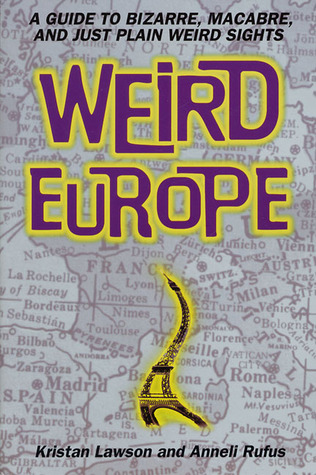
So Google is your friend. But how did travellers find those coolest places before internet? Believe me or not, but there are these things called books! I ran into a wonderfully named guide, Weird Europe (by Kristan Lawson & Anneli Rufus), which is already quite old, my copy being 1999 edition. But it promises bizarre, macabre and just plain weird sights to its reader, including sewer tours, two-headed animals, pictures drawn by dead people and underground cities. It's just a book for me, and despite its age, most of the attractions are still there. Well, the Beatles Museum in Cologne has moved, but the caves, crypts and tombs seldom wander away from their present location. With this book I found about this awesome hedge maze next to a three-country-borderstone, got reminded of certain church chamber that has walls decorated with human bones (video link) and discovered an underground river in Belgium (who would have thought that there are such a many caves in Belgium). Many of the places I have already visited, and I happen to know few attractions that should be mentioned in the book that aren't there, but one thing is sure: I'll never leave for a European country any more without checking Weird Europe contents and index first.

8.1.13

Payback

A camera is one of the most common and distinctive single characteristics of a tourist. Everyone knows the hordes of the Japanese tourists swarming all over the world photographing every silliest detail they can find. But most 'western' tourists also have for decades taken for granted that they can travel to another country and take photos of children, animals, beggars, homes, old people, religious sites, people at their work and so on. Many times without asking a permission. I know I have. Then I travelled to India.

It began already in Mumbai. On the very touristy island of Elephanta some Indian people wanted to have themselves photographed with my six-year-old son. Well, he's blonde haired and pale skinned, so I guess he can look quite exotic in Indian eyes. A man touched his hair, then kissed his own fingers and took them on his heart. A lucky touch? One would think a huge city like Mumbai sees its share of caucasian tourists so regularly that it wouldn't be so big a deal, but then these people were most probably tourists in Mumbai themselves. Little did we know that it was just a small taste of what was to come.

We flew to the island of Diu, which is a former Portuguese colony just below the state of Gujarat. It has an old fort, some beautiful beaches, resorts, churches, temples and other sights, but compared to e.g. some parts of Goa, it's very small-scale, relaxed and laid-back. Foreign travel agencies don't bring people here. Tourists have to find this place themselves. On the other hand, Diu is to a great extent a holiday island to the Gujarati people. The big Indian state of Gujarat is a dry one - the local hero, no one less than Mahatma Gandhi himself, didn't have a taste for booze, so alcohol is banned for the rest of the people too. It's legal in Diu, however, so a drunk Gujarati is not a rare sight on the island, especially during big holidays like Diwali, Christmas or New Year.

Local people on Diu probably see caucasian tourists enough so that they're not that impressed, but the (often tipsy and uninhibited) Gujarati tourists often don't hesitate to show their astonishment of seeing exotic-looking palefaces. - Hello! Where are you from? Your name? Nationality? Profession? One photo? One only! they'd typically ask. Then, when the photographing permission is granted, they take turns to pose with the unusual westerners. Most of them are very friendly and clearly earnest. We got sincere invitations to visit people's homes only three hours drive! away from Diu. I still have a piece of paper on which a guy wrote three different phone numbers of his so that I could call him, the reason I really don't know. He didn't even speak English.

Then there's the awkwardness of this type of behaviour. No matter if you're absorbed in your book or otherwise look like you'd like to be alone: One photo only! If you're a woman in a bikini on a beach, you can be sure the mobile phone cameras will lick your body from head to toes. Without a male companion the thin line of harassment can get stepped over very easily. One kiss please! Just one kiss! 

In the end, the photographing and the curiousness towards western looking people is, of course, just a retaliation for all the photos the western people have taken over the years. It's a matter of taking something and giving something. On Diu we rarely denied the photographing, and posed for most photographs when asked. More annoying was to notice being shot on video or photos on the beach without having asked permission. Then again, I've done that too. It's just a payback.

3.12.12

Soaking up Siberia - Vodka (and Wine)

I'm positive it's possible to travel across Russia without having a single drop of vodka, but I have to admit did have a drop or two. We bought a bottle of locally made product from a shop next to Moscow station to be consumed by taking a shot once or twice every day. Strictly for medicinal pruposes, you know. I have never been any particular fan of vodka, even though I'm supposed to live on the Vodka Belt, but normally I won't turn down a shot if offered.

Salmiak vodka and some Chinese buildings at the background.
Travellers on the Trans Siberian railway are often advised to be prepared of getting a share of local passengers' provisions. It's also advisable to offer your food or drinks to other people travelling with you. So I grabbed a bottle of Salmiakki Koskenkorva, a popular vodka-based Finnish liqueur spiced with salty liquorice with me to be shared during the trip. Since I travelled the first half of the Trans Siberian trip in the first class compartment, there wasn't too many opportunities to share anything. After Irkutsk there was an American father & son in the same compartment with us, but since the boy was clearly under-aged, I decided better not to offer any alcohol around. Food-based supplies were shared, of course!

After 9000+ kilometres and half a  litre of vodka.
When we left Ulan Bator we got new train and new mates to share the train car compartment. Whether it was a pure coincidence, or some sneaky antics of the Mongolian railway authorities, they were Finns! Several thousands of kilometres through two continents, and here we sat, four Finns: us, father and son and our new travelling companions, mother and daughter. It didn't take too long to dig up the salmiak vodka and raise a toast to being a Finn on a Trans Siberian train. During the next 24 hours we had toasted the whole bottle empty, not much before the train pulled to the railway station in Beijing.


If you watch carefully, you might spot our wine bottle
on the other side of the window.
I mentioned wine in the topic, didn't I? Yeah, we had some on the rail. In Moscow, when we purchased the medicinal vodka bottle at the shop near the station, we also bought a bottle of wine. To go with the meals, you know. There was a good assortment of wines to choose from in the shop, many brands being familiar from Finnish alcohol selling establishments already. It was good wine, I have to admit. However, it remained the only bottle of wine we ended up having during the trip. Beer seemed to be the most suitable (alcoholic) drink for the hot hot hot summer of 2010 on the Trans Siberian railway.

Next: Beer

Previous chapters of Soaking up Siberia:
- Tea and Coffee
- Kvass

28.10.12

Habsburgs Rest in Pieces

Monarchs and other rulers usually want to make themselves remembered, one way or another. Pyramids, anyone? I'm particularly fond of the way the Habsburg dynasty (the Austrian emperor line, the House of Habsburg-Lorraine) has immortalised themselves by even harnessing the Viennese urban planning into action. When a member of the Habsburg family dies, he or she becomes embalmed, almost like the ancient upper-class Egyptians. The body is prepared for the sarcophagus, for the post-funeral display, whereas the heart and the rest of the entrails are preserved in separate metal urns - silver for the heart and copper for intestines and other organs. And like in a proper canonising process, people are encouraged to visit the crypts where the different body parts are laid to rest.

The Habsburg royalty are entombed in the very centre of Vienna, of course, but every family member is ingeniously separated in three different places, so there will be more burial sites for the royal subjects to visit. The hearts can be found in the Herzgruft (Heart Crypt) in the Augustinian Church. The guts are displayed in the Herzogsgruft (Ducal Crypt), situated in the catacombs of Stephansdom (St. Stephen's Cathedral), the most ostentatious landmark in Vienna. The embalmed bodies of the royalty lay in their sarcophagi in Kaisergruft (Imperial Crypt) below the Capuchin church. The guide showing the Ducal crypt told that despite the double sealing of the urns one of them started leaking some time ago, filling the catacombs with horrible deathly smell of rotting innards.

In the Imperial Crypt you can witness the ornament race on the sarcophagi. The oldest are simple metal coffins, but by walking deeper in the crypt the decorations of the newer caskets grow in spectacular proportions. The further you go the more ornaments, crowned Death's heads, veiled semi-nude women and cherubs there are on the sarcophagi. The winner is undoubtedly the stupendous double tomb of Empress Maria Theresa and her husband, Francis I Stephen, which can also be seen in the video below. Pay attention to the weird knight(?) on the side that looks like a wooden pole is wearing an armour. Towards the end of the crypt the newest tombs like the are again more discreet, like in the vault of beloved couple Emperor Franz Joseph and Empress Sissi and their son Rudolf.

In the end of the video below the alarm goes off when I'm shooting the death's head ornament from close distance. I'm not sure if it was me setting it off...

11.9.12

Pedestrian Roller Coaster

Photo © Guy Gorek
If you are really afraid of roller coasters, but still would like to take a ride, you should head to Duisburg, Germany, where you can take a walk on one. It's actually a sculpture that was built about a year ago on a hilltop of landscaped mining waste, just next to the river Rhein. It's called Tiger & Turtle - A Magic mountain, because a roller coaster is normally fast like tiger, but this one you can walk as slowly as a turtle. It's accessible for free at all times of the day, and it's even illuminated after dusk.

This is exactly what is cool in the ostensibly miserable and ugly Ruhr area: You can find a number of industrial landmarks, disused factories etc. which have been innovatively converted into new uses. Some day I'll go back there to take a scuba dive session in a gasometer. In Ruhr area that is possible too. Meanwhile take a look at the head camera video I filmed at the Tiger & Turtle landmark. Can you walk the loop?

2.9.12

Soaking up Siberia - Kvass

I made my first acquaintance with popular Russian soft drink kvass in Moscow after the first night spent in the train from Finland. The Trans Siberian trip was about to continue in the evening so we had a good opportunity to sightsee some of the Russian capital city. The day was boiling hot, but luckily there was a matryoshka selling cold kvass on draught in the park next to Kremlin. The nice and cold beverage was perfect to go with some lazy park bench-sitting (until a guard came out of nowhere and told the park is getting closed and we have to leave. Closed? In the middle of the day?) Kvass is traditional fermented low-alcohol drink made by fermenting grain or bread. The Russian brands I had during my trip were a bit different, e.g. sweeter than its Finnish equivalent kotikalja, still really good.

Kvass sold from a tank at the market place
As a matter of fact it was so good that later on the trip I bought a 1,5 litre bottle of kvass from a small kiosk on Novosibirsk station platform. The beverage was tad warm for my taste from the beginning and the flavour was somehow more artificial than those couple of pints I had drunk earlier in Moscow. Nevertheless I drank it all, the last drops maybe 30-35 hours later when the train pulled to Irkutsk station where we jumped off for couple of days. Big mistake! Little did I think of the fact that I had kept this fermented drink in warm train carriage conditions for a day and a half. If it wasn't already spoiled at the moment of purchase, it probably was by the time I gulped down what was on the bottle bottom before leaving the train. In few hours after finishing the bottle my stomach chanted diarrhoea cha cha cha. I survived the gastric dysfunctions by feeling merely under the weather for couple of days, so at least I didn't have to lie in bed for days. But it was quite an accomplishment to spoil one's own beverage and then drink it!

Next: Vodka (and Wine)

Previous chapter of Soaking up Siberia:
- Tea and Coffee

16.8.12

Fine Titz

Got a genuine old-skool snail mail letter from Germany couple of days ago. Uh oh, these things have never meant anything good, I thought. It was a speeding ticket from couple of weeks ago from a trip to Ruhr area and Benelux. Looks like it is possible to exceed the speed limit even in Germany! Fortunately the twenty euro fine I have to pay is considerably less than the 750 € that I was dunned for in the case explained behind the previous link. Moreover, the car rental company charged me an additional fee for passing my information to the authorities, but I guess that's only fair.

The felony took place in a town called Titz. No wonder your driving was so hasty and excited, said wife. 

7.8.12

Soaking up Siberia - Tea & Coffee

Nice cups of tea sold by provodnika.
When traveling around, one of the most interesting and fun things is often paying attention to cultural differences in eating and drinking products, habits and customs. Like I have mentioned in this blog earlier, I try to taste local products, drinks, cheeses, specialities wherever I go. Usually the experience is fascinating, sometimes it's nothing special to remember, some other times it's not necessarily something you would like to go through again, but nevertheless, you're one experience richer anyway. During my Trans Siberian trip I had an opportunity to observe some details of foreign drinking habits and especially the beverages themselves. I decided to write a small series on the topic. So let's soak it up and start with tea and coffee.


Perm station vendors
Before leaving Finland for the Trans Siberian trip, I heard a supposedly useful advice on having coffee and tea in Russia: If you're a coffee drinker, better learn to like tea. The advice hinted that tea works generally better as tea in Russia than coffee works as coffee. Fair enough, since I am definitely more of a coffee drinker, my cunning plan was to take some instant coffee with me, so I would at least be able to get my morning fix. Of course, in the end I forgot that unfortunate jar of instant coffee home.

Looking for tea bags.


There is always hot water available from a samovar in Russian trains you'll be able to brew your own tea or coffee on the rail. Of course, provodniki (the train stewardesses) can sell you whatever beverages you want, but in the long run (and Trans Siberian is long) it's more inexpensive to bring your own stuff with you or buy it at the stations during the stops. I tried to purchase tea bags from the station platform vendors on the first few stops by asking for чай (or rather: chai), but I was always offered ice tea bottled by multinational corporations. Even my weird tea bag bobbing hand mimics accompanied with my chai-chanting  didn't lead to a purchase. Finally a good woman on the platform of Perm station dug up a package of Russian tea bags from her booth.

Samovar. Get your hot water here.
As for coffee, I mentally prepared to have my last good tasting cup of coffee at a way overpriced coffee shop on Moscow's more touristy area, the pedestrian Arbat street during the second day of our voyage. And an excellent cup it was. But those couple of times I had some coffee elsewhere on the trip, like in the hotels at Irkutsk and Beijing, weren't totally bad. I've gotten used to that coffee just tastes different in other countries than what it's like at home. While some people might think it's bad coffee and get a cold turkey on caffeine during their vacation, I will just settle for another, typically unfamiliar and strange flavour. It's a simple take it or leave it situation, and being a coffee junkie, I like to take it.

Next: Soaking up Siberia - Kvass

21.7.12

A-maze-ing Borderlands

A boy in Germany, Belgium and The Netherlands
Borders between countries have always interested me. At most places you need to jump through a ton of bureaucratic hoops to cross one. Some places need you to assure with your signature that you are not lunatic, genocidal or a Nazi. The thing I like in the current Europe is that you can cross the borders in most countries by merely stepping over them. No grim faced guards with their guns, no endless car queues, no visa fuzz accomppanied by silly questions. Just go there.

There's also often a change of the language when you go to the other side of a border. However, in border areas the population often mixes with the population on the other side. They share the same culture and often the surrounding languages are spoken fluently in the area. Often also a certain laid-back atmosphere can be detected; people are used to visitors and cultural differences and strangers are not looked upon as weird freaks.

So close, yet so far away.
Those were the lines of our thoughts when we were having breakfast in a local pastry shop in a small Dutch town of Vaals, bordering nearby Belgium and Germany. An elderly couple at the next table were apparently keenly listening to our foreign chatting and when I dug up a map to study, the man saw the opportunity to start a conversation with us asking in very good English if they could help us with the directions. After telling us the way to the nearby three lands point he asked the question that had obviously bugged them since the beginning: What is the language we are speaking? After revealing it's Finnish the woman raised her thumbs up as in a sign of victory. It remained unclear what the man thought our language was. The couple was one of those borderland 'mixed' people, the man being Dutch and and the woman German. They said their common language was mostly German. After the nice chat they left, but soon the man came suddenly back, handing us a little bag of Aachener Printen, local traditional cookie delicacy, as a present and a wish for safe travels. I'd like to think we just encountered some real borderland hospitality!

Wait...                                             ...go!
We went on to see the Drielandenpunt where the Netherlands, Germany and Belgium collide. The place is made into a tourist attraction with sightseeing towers, parking lots, restaurants, gift shops and playgrounds. You can run around the border stone as many times as you want entering from one country to another in seconds, or even be in all the three countries at the same time by sitting on the stone. The highest point of the Netherlands is also here: You can't get higher than 322,5 metres in Holland. 

One way to find a way.
The most fun thing here, however, is The Labyrinth. There is a supercool hedge maze here, where the goal is to reach the platform in the very center of the labyrinth. It's difficult enough as it is already but they have added some 'stone' gates there with built-in water fountains that will wet you badly if you walked through. You have to find a hidden sensor nearby and waving your foot or hand next to it will stop the water for a moment  of unknown length. Better walk through the gate quickly. It gets only more interesting when you spot the sensor on the other side of the gate... There are also three lesser platforms built along the way where you can plan your route towards the center of the maze and watch the other people running into dead ends. On average it takes 30-45 minutes for the visitors to reach the goal and I think that's about what it took us too.

29.6.12

Paris Catacombs Photo

Skimmed through some old photo albums and found this picture of me (right) and and my friend in the catacombs of Paris during an Interrail trip some twenty years (and kilograms) ago. Time to visit Paris again at some point!

21.5.12

Loughborough Family Butcher

Low quality mobile phone camera snapshot.
After visiting a local business photographer, I walk in the centre of Loughborough. It's a busy sunny summer afternoon. People are running errands in the post office, shopping their groceries after work. Some are already having their first pint in a pub. Lots of cars driving around. A typical and nice day in a typical and nice English small town.

There I walk, minding my own business, when suddenly I spot an eerie establishment on the other side of the street. It's like a shop, because of the large display windows, but all the windows, including the door glass seem to be covered by brown packaging paper from inside. Above there is a sign with the text:

EDDIE BAILEY
FAMILY BUTCHER
Screen cap from Google Street View.
I never went inside the store. Wonder what it looks like behind those brown paper wrappers. I bet it's a real old-skool butcher's shop. Carvers, hooks and knives hanging from the ceiling and walls. More cutting tools and a big roll of that brown wrapper on a cutting block. Eddie himself standing behind the counter with a huge cleaver in his hand wearing somewhat bloody apron and a white trilby hat with a big smile on his face. Guess I'll take my wife and son there the next time we visit Loughborough. Maybe Eddie gives us family discount!


6.5.12

Hidden Camera in a Bone Crypt

I blogged earlier of the Capuchin crypt in Rome, which is decorated mostly with human bones. As I happened to have a spy camera (camouflaged as a pen) with me, I used it to shoot some footage of the skeletal ornaments and bone piles. The quality is obviously horrible, lighting almost nonexistent and the camera keeps moving annoyingly all the time, but anyway, here's a small video glance into the notorious bone crypt.

28.4.12

Vienna Sewers with the Third Man - This One's a Stinker!

Very much like I bumped into the Polanski film Cul-de-sac's tv-cast, and ended up visiting the filming locations later, I happened to watch Carol Reed's great classic The Third Man and had to Google right away the whereabouts of the shooting locations. Indeed, there are at least an organised walking tour, a museum dedicated entirely to the Third Man movie, and a tour in the sewers. Sewers! I had been in Vienna couple of times earlier, but it never occurred me you can actually enter the sewage system and experience the real deal yourself. The sewer walking tours are operated by the Vienna sewage system maintenance guys themselves, so in addition to witnessing some authentic Third Man locations, you'll get to learn about the history and the present of the Viennese waste water system and witness the actual movements of bowel movements...

In the movie the water was flooding over that wall.
The sewers entrance was at the very same spot where Orson Welles' character Harry Lime escaped his pursuers. The building in the background was easily recognisable from the film, and especially the underground entrance with it's peculiar opening splitting in triangular parts and the underground spiral stairway were really familiar looking. Next to the entrance there was a giant red concrete sculpture depicting a sewer system manhole grating, a shape which serves as a mutual symbol for different Third Man attractions in Vienna the two other of which are a walking tour and a museum.

Before entering the sewers the guide handed out helmets for everyone and down we went. Quite soon it became also nasally quite obvious that we were indeed in a sewage system. The tour included four or five stops where the guide told us about the sewer system operation and some of them were easily recognised as actual filming spots from the movie. On couple of these undeground locations there were nice multivision slideshow montages projected creatively using the sewer architecture as screen. In the slowly flowing channels the waste of  Vienna was drifting with all imaginable human bodily secretions.

Back on the ground we gave back the helmets. The disinfectant liquid that was put available for the visitors was really popular.

16.4.12

Pop Rice Vietnamese Style

The Singing Cock
At Mekong delta there are many places where local people show tourists how to make pop rice Vietnamese style. Basically the idea is the same as in making pop corn, but a rice grain has to have certain amount of moisture in it to be popped. I would also assume that the grain has to have its shell to be able to pop, so if you're going to try it at home, make sure to use unmilled rice. What makes the rice popping special in a village at Mekong delta is the use of heated black sand in the process. The rice is poured in a large hot pan with sand already in it, and it is vigorously stirred until the rice starts to pop. Then the contents of the pan is sifted so that popped rice remains in the sieve and the sand goes back in the pan. The popping itself takes no more than 20-30 seconds. The taste is somewhat close to pop corn, still different. Apparently there is no oil used in Vietnamese style, at least where we witnessed rice popping, so snack-wise pop rice isn't very unhealthy.

The following video shows the popping part. There was a hennery nearby, and the cock was constantly singing every few minutes. Apparently it somehow got on my two-year-old son's nerves, since he started imitate the cock-a-doodle-doo song every time the cock sung. You can hear both the cock and my son singing during the first seconds of the video clip.

11.4.12

The Mummified Monk of Samui

The shrine
Koh Samui's top attraction? Easy: the mummified body of Loung Por Daeng (aka Phra Khru Samathakittikhun aka Dang Piyasilo), a Buddhist monk, who predicted his own death, which occurred at 1973. He died while meditating at the age of 79. The body didn't decompose normally, but was rather mummified probably by dehydrating very quickly. After decades he still is in amazingly good shape. At least for a dead guy, that is.

He left his disciples instructions to place his body in the temple of Wat Kunaram in an upright cross-legged position 'to aspire the future generations to follow the Buddhist teachings and be saved from suffering'. The story doesn't tell if it was also his instructions to have those nifty Ray-Bans, but they were said to be placed on the remains of his nose, because his sunken eyes started to look ghastly. To be honest, the result - a shades-wearing mummy monk sitting in a glass casket (like Rascar Capac in a Tintin comic!) - is still a tad appalling.

Loung Por Daen
I'm not sure if he was still alive when this photo was taken.

28.3.12

Holy Island

Happened a few years ago: Roman Polanski's film Cul-De-Sac was on the television. Cool, a Polanski I hadn't seen yet. It was rather an unusual modern crime story set up in very unusual premises - in a 16th century castle on a tidal island. The beginning of the film depicted quite an unforgettable situation where the road to the island was submerged by the high tide, and people in the castle watched a car stuck in the middle of the causeway, about to be washed away by the sea.

Sea bottom
The film was excellent and the weird location even more intriguing. The almighty internet confirmed that the place was real, the island of Lindisfarne, the name is actually mentioned in the movie too. In addition to the castle there is also a monastery ruins from the 7th century and a little village, both of which had been left out of the Polanski movie. The island and nearby Bamburgh castle also play significant role in Bernard Cornwell's great Saxon Stories. Bamburgh is actually visible from the island. Our next trip to the United Kingdom provided us an opportunity to go see the actual place.

The locals advised to take the timetables seriously into account when crossing the causeway to the island. Every year several cars (mostly tourists and daredevils) get stranded on the causeway by a high tide. There even is a small hut built on poles at the middle point of the causeway where you hopefully can wade into safety if you're about to get washed into the sea. Once the causeway and the surrounding sea bottom are dry, it's possible to stop in the middle part of the causeway and go walk where the sea was just a while ago.


Monastery ruins
The island is famous also for the Lindisfarne Mead that is sold near the monastery ruins. Undoubtedly the recipe is more than 1000 years old, who knows, officially they have made the present product since 1960's. The mead was a pleasant new acquaintance once we got home and had a taste of what we had bought. Way different from the Finnish variety of mead, sima, which we drink around the May Day. I can imagine the happy vikings carrying barrels after barrels into their ships once they had raided the monastery brew house.

The castle is also open for visitors. It's worth seeing, even without seeing the Polanski film, but it's always cool to visit real places that have been used as film sets. The castle itself looks somewhat out-of-the-place standing alone on top of a rock on otherwise rather flat island. The climb on the cobblestones is steep, so as a fortification the castle, being rather small, seems it might've worked well for the purpose. Nowadays the sheep are the only invaders around the castle area.


Some other guy's (Ian Britton FreeFoto.com) photo. We didn't get to see this happening...

14.3.12

Camino del Rey - the Photo Gallery

The story I wrote about my last summer hiking trip on Camino del rey in Spain is the most read story in this blog right now. I made a small gallery of some photos I haven't published yet from the the trip for everyone interested enough. The popular 10-minute video is still in the original blog entry, and a shorter abseiling video can be found in its own blog entry. Enjoy the photos here:

Camino del Rey Gallery