Buy This Book from Book Depository, Free Delivery World Wide
Showing posts with label travel thoughts. Show all posts

28.8.13

Weird Europe - How to Find Unusual Attractions

Frightened tourists on an Edinburgh ghost tour.
When I'm traveling, I usually try to find if there's something unusual or exceptional to do or to see in the area. Sometimes even the most common touristy places have totally 'something different' to offer. For example, I never fancied the idea of going to Spanish Costa del sol, which has practically been covered with concrete over the last five decades and which annually sees way more tourists than local people. Of course, there are the wonderful caves of Nerja and the magnificent Alhambra castle in the area, which despite their being perfect school-book examples of tourist traps, are truly mystical and awe-inspiring must-see destinations for anyone. Then again, I dug some more and found out about El camino del rey, the infamous scariest footpath in the world. It's just around the corner in the Sunny Coast, but when I was there the first time I had no idea of the place. The second visit, after some research, resulted to one of the daunting trips I've ever made. Read more about it here.

Lurgrotte Semriach (Austria) gone phallic.
But how to find those different places? How to find the path less travelled? Most tourists don't have the opportunity to spend months and months drifting around, finding the coolest places and the secret beaches that no one has ever heard of. Usually it's the one or two week dash to the destination, some hanging around there, then back home and to the rat race. You can be lucky and find that awesome waterfall or that spectacular food selling street vendor, but it never hurts to do your homework before you even start packing. Usually I start by Googling if there are caves near the destination. Caves are cool (yes, literally too). I mentioned the Nerja caves above, but I've visited also couple of others. Sailed on an underwater river in Belgium. Become awestruck by the Naida caves on an Indian island (video link). Another must-Google for me are ossuaries. I've seen only few of the many European ones and they're fascinating. I'll definitely visit any if there's one nearby my destination.

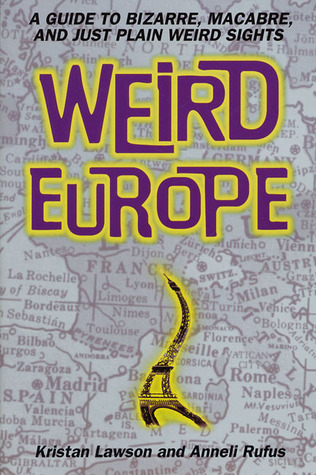
So Google is your friend. But how did travellers find those coolest places before internet? Believe me or not, but there are these things called books! I ran into a wonderfully named guide, Weird Europe (by Kristan Lawson & Anneli Rufus), which is already quite old, my copy being 1999 edition. But it promises bizarre, macabre and just plain weird sights to its reader, including sewer tours, two-headed animals, pictures drawn by dead people and underground cities. It's just a book for me, and despite its age, most of the attractions are still there. Well, the Beatles Museum in Cologne has moved, but the caves, crypts and tombs seldom wander away from their present location. With this book I found about this awesome hedge maze next to a three-country-borderstone, got reminded of certain church chamber that has walls decorated with human bones (video link) and discovered an underground river in Belgium (who would have thought that there are such a many caves in Belgium). Many of the places I have already visited, and I happen to know few attractions that should be mentioned in the book that aren't there, but one thing is sure: I'll never leave for a European country any more without checking Weird Europe contents and index first.

8.1.13

Payback

A camera is one of the most common and distinctive single characteristics of a tourist. Everyone knows the hordes of the Japanese tourists swarming all over the world photographing every silliest detail they can find. But most 'western' tourists also have for decades taken for granted that they can travel to another country and take photos of children, animals, beggars, homes, old people, religious sites, people at their work and so on. Many times without asking a permission. I know I have. Then I travelled to India.

It began already in Mumbai. On the very touristy island of Elephanta some Indian people wanted to have themselves photographed with my six-year-old son. Well, he's blonde haired and pale skinned, so I guess he can look quite exotic in Indian eyes. A man touched his hair, then kissed his own fingers and took them on his heart. A lucky touch? One would think a huge city like Mumbai sees its share of caucasian tourists so regularly that it wouldn't be so big a deal, but then these people were most probably tourists in Mumbai themselves. Little did we know that it was just a small taste of what was to come.

We flew to the island of Diu, which is a former Portuguese colony just below the state of Gujarat. It has an old fort, some beautiful beaches, resorts, churches, temples and other sights, but compared to e.g. some parts of Goa, it's very small-scale, relaxed and laid-back. Foreign travel agencies don't bring people here. Tourists have to find this place themselves. On the other hand, Diu is to a great extent a holiday island to the Gujarati people. The big Indian state of Gujarat is a dry one - the local hero, no one less than Mahatma Gandhi himself, didn't have a taste for booze, so alcohol is banned for the rest of the people too. It's legal in Diu, however, so a drunk Gujarati is not a rare sight on the island, especially during big holidays like Diwali, Christmas or New Year.

Local people on Diu probably see caucasian tourists enough so that they're not that impressed, but the (often tipsy and uninhibited) Gujarati tourists often don't hesitate to show their astonishment of seeing exotic-looking palefaces. - Hello! Where are you from? Your name? Nationality? Profession? One photo? One only! they'd typically ask. Then, when the photographing permission is granted, they take turns to pose with the unusual westerners. Most of them are very friendly and clearly earnest. We got sincere invitations to visit people's homes only three hours drive! away from Diu. I still have a piece of paper on which a guy wrote three different phone numbers of his so that I could call him, the reason I really don't know. He didn't even speak English.

Then there's the awkwardness of this type of behaviour. No matter if you're absorbed in your book or otherwise look like you'd like to be alone: One photo only! If you're a woman in a bikini on a beach, you can be sure the mobile phone cameras will lick your body from head to toes. Without a male companion the thin line of harassment can get stepped over very easily. One kiss please! Just one kiss! 

In the end, the photographing and the curiousness towards western looking people is, of course, just a retaliation for all the photos the western people have taken over the years. It's a matter of taking something and giving something. On Diu we rarely denied the photographing, and posed for most photographs when asked. More annoying was to notice being shot on video or photos on the beach without having asked permission. Then again, I've done that too. It's just a payback.

7.8.12

Soaking up Siberia - Tea & Coffee

Nice cups of tea sold by provodnika.
When traveling around, one of the most interesting and fun things is often paying attention to cultural differences in eating and drinking products, habits and customs. Like I have mentioned in this blog earlier, I try to taste local products, drinks, cheeses, specialities wherever I go. Usually the experience is fascinating, sometimes it's nothing special to remember, some other times it's not necessarily something you would like to go through again, but nevertheless, you're one experience richer anyway. During my Trans Siberian trip I had an opportunity to observe some details of foreign drinking habits and especially the beverages themselves. I decided to write a small series on the topic. So let's soak it up and start with tea and coffee.


Perm station vendors
Before leaving Finland for the Trans Siberian trip, I heard a supposedly useful advice on having coffee and tea in Russia: If you're a coffee drinker, better learn to like tea. The advice hinted that tea works generally better as tea in Russia than coffee works as coffee. Fair enough, since I am definitely more of a coffee drinker, my cunning plan was to take some instant coffee with me, so I would at least be able to get my morning fix. Of course, in the end I forgot that unfortunate jar of instant coffee home.

Looking for tea bags.


There is always hot water available from a samovar in Russian trains you'll be able to brew your own tea or coffee on the rail. Of course, provodniki (the train stewardesses) can sell you whatever beverages you want, but in the long run (and Trans Siberian is long) it's more inexpensive to bring your own stuff with you or buy it at the stations during the stops. I tried to purchase tea bags from the station platform vendors on the first few stops by asking for чай (or rather: chai), but I was always offered ice tea bottled by multinational corporations. Even my weird tea bag bobbing hand mimics accompanied with my chai-chanting  didn't lead to a purchase. Finally a good woman on the platform of Perm station dug up a package of Russian tea bags from her booth.

Samovar. Get your hot water here.
As for coffee, I mentally prepared to have my last good tasting cup of coffee at a way overpriced coffee shop on Moscow's more touristy area, the pedestrian Arbat street during the second day of our voyage. And an excellent cup it was. But those couple of times I had some coffee elsewhere on the trip, like in the hotels at Irkutsk and Beijing, weren't totally bad. I've gotten used to that coffee just tastes different in other countries than what it's like at home. While some people might think it's bad coffee and get a cold turkey on caffeine during their vacation, I will just settle for another, typically unfamiliar and strange flavour. It's a simple take it or leave it situation, and being a coffee junkie, I like to take it.

Next: Soaking up Siberia - Kvass

21.7.12

A-maze-ing Borderlands

A boy in Germany, Belgium and The Netherlands
Borders between countries have always interested me. At most places you need to jump through a ton of bureaucratic hoops to cross one. Some places need you to assure with your signature that you are not lunatic, genocidal or a Nazi. The thing I like in the current Europe is that you can cross the borders in most countries by merely stepping over them. No grim faced guards with their guns, no endless car queues, no visa fuzz accomppanied by silly questions. Just go there.

There's also often a change of the language when you go to the other side of a border. However, in border areas the population often mixes with the population on the other side. They share the same culture and often the surrounding languages are spoken fluently in the area. Often also a certain laid-back atmosphere can be detected; people are used to visitors and cultural differences and strangers are not looked upon as weird freaks.

So close, yet so far away.
Those were the lines of our thoughts when we were having breakfast in a local pastry shop in a small Dutch town of Vaals, bordering nearby Belgium and Germany. An elderly couple at the next table were apparently keenly listening to our foreign chatting and when I dug up a map to study, the man saw the opportunity to start a conversation with us asking in very good English if they could help us with the directions. After telling us the way to the nearby three lands point he asked the question that had obviously bugged them since the beginning: What is the language we are speaking? After revealing it's Finnish the woman raised her thumbs up as in a sign of victory. It remained unclear what the man thought our language was. The couple was one of those borderland 'mixed' people, the man being Dutch and and the woman German. They said their common language was mostly German. After the nice chat they left, but soon the man came suddenly back, handing us a little bag of Aachener Printen, local traditional cookie delicacy, as a present and a wish for safe travels. I'd like to think we just encountered some real borderland hospitality!

Wait...                                             ...go!
We went on to see the Drielandenpunt where the Netherlands, Germany and Belgium collide. The place is made into a tourist attraction with sightseeing towers, parking lots, restaurants, gift shops and playgrounds. You can run around the border stone as many times as you want entering from one country to another in seconds, or even be in all the three countries at the same time by sitting on the stone. The highest point of the Netherlands is also here: You can't get higher than 322,5 metres in Holland. 

One way to find a way.
The most fun thing here, however, is The Labyrinth. There is a supercool hedge maze here, where the goal is to reach the platform in the very center of the labyrinth. It's difficult enough as it is already but they have added some 'stone' gates there with built-in water fountains that will wet you badly if you walked through. You have to find a hidden sensor nearby and waving your foot or hand next to it will stop the water for a moment  of unknown length. Better walk through the gate quickly. It gets only more interesting when you spot the sensor on the other side of the gate... There are also three lesser platforms built along the way where you can plan your route towards the center of the maze and watch the other people running into dead ends. On average it takes 30-45 minutes for the visitors to reach the goal and I think that's about what it took us too.

10.8.11

First Proposers

Rule of thumb: Whenever you arrive to a country or some new place when travelling, the first person proposing something usually tries to cheat or trick you some way or another. In its mildest and most common form the person is overcharging you from his/her service.

Example 1. (Beijing, December 2004)

Made it to the Forbidden City after all.
A 12 hour stopover at Beijing! What a nice chance to go check downtown. Even the day visas could be neatly arranged from the certain counter in the airport. (The embassy in Finland had told that it wouldn't be possible and that we would have to buy visas from them. Wrong! Luckily we didn't believe them.)

Hop into a taxi and off towards the Tiananmen Square. It takes couple of kilometers of driving before the jet lagged and tired travellers notice that the meter is not turned on. In fact, there is no meter at all, just a gaping hole in the dashboard. We start negotiating - the driver asks about quadruple price of what I know should be a 'real price'. At the square we still fight over the price. The driver yells angrily. We manage to drop the price to the half of driver's original amount, still being about double the normal amount. When I pay, the driver is grinning at me. I could read the expression on his face: Sorry pal, this is how it goes.


Example 2. (Irkustk, July 2010)

Next stop: Irkutsk.
Our train pulls into station at 6 am. The hotel is booked and paid in advance, but me and my father still need to get in there. The distance is only couple of kilometres, but I don't really feel like wandering in a Russian city in the morning darkness with all our luggage after four straight days in a train. Especially with my old man. Oh, but we don't have to! A friendly chap in the passenger hall walks to us, offering a 'taxi' ride to the hotel for 300 rubles. Oh well, that's under 10 euros, and people's taxi is almost an institution in Russia. Outside the railway station there is a row of official cabs as well, but we already made the deal. Our driver takes us safely to the hotel and even lifts our bags out of the car. Spasibo & do svidaniya.

After couple of days our voyage continues, and we need to get to the railway station again. The hotel receptionist books us a taxi for 4.30 am. This cab has even a proper taxi sign on the roof. The driver takes us quickly to the station but doesn't take our bags out of the car. My father reckons the fee will have an added nighttime service charge. We end up paying 150 rubles.


Example 3. (Russian-Mongolian border, July 2010)

Right after crossing the border a multitude of money exchangers swarms into the train. You can't get Mongolian tögröks (or tugriks) outside Mongolia, so the first opportunity to get that money is NOW! Well, let's take it easy, we don't need that much cash right now in the beginning, how about 1000 rubles, some thirty euros. Our carriage's exchanger presents a rate of 1:20. Up to twenty tögröks for a single ruble - hey but that is a lot! The fellow explains that they don't accept rubles any more in Mongolian exchange booths, so if we don't go back to Russia any more, we better change now. Hmm, sounds like a sales pitch, but hell, take another thousand rubles and gimme TWENTY GRAND more!
Almost invaluable one tögrök note. (0,0006 EUR)

The ruble rate at Ulan Bator's money exchange offices turns later out to be 1:43. The exchange creep in the train visits our cabin at least twice again before leaving the vehicle - just to make sure if we still want to exchange more rubles. When he walks away the aisle, I hear him muttering to himself: 'money money money money...'

24.4.11

Google Maps Street View

Google Maps Street View is wonderful! Recently I was writing this story about a drunken man in New Orleans. I wanted to find the exact place for my blog map, but I didn't remeber even the name of the bar in question, and I had only a faint idea of the whereabouts of the hostel we stayed at that time.

So first I Googled 'hostels new orleans'. Hmmm... that Marquette House sounds remotely familiar. Let's see where it is. Carondelet Street? Equally familiar sounding. So let's take a look with Street View. Hey, that's it! There's even the spot we parked our car!

But how am I going to find the bar we were? Ok, I vaguely remember the short route we walked to the site. It's fairly easy to navigate in Street View by taking small steps at the time. It must have been on St. Charles Avenue, because the street cars run here... no, this must be the wrong direction, how about the other way... Igor's? That looks familiar... and they have laundromats, that's it! That's the place!

It was almost like walking there again ...well, not at all, but you get the idea. I also found some photos taken inside the bar, so that was definitely the same place we walked in almost ten years ago. It's one thing to cast your mind back to some far-off trip you've made ten(s of) years ago but being able to 'walk' the very same streets on your screen certainly adds to the memory.

25.2.11

Been There, Done What?

A place to accomplish the 2W1P in China.
A popular travellers' dilemma is: How do you count the countries you've been to? At the first glance it would seem the simplest question - just count 'em, man! But when you start to look into the matter you'll very soon notice different people have a very different number and kind of trip prerequisites one has to meet before the visit counts. Typically for many people airport stopovers don't count. Some of them might allow them as a visit, if you walk outside the airport building. Some say you have to spend at least one night or use money there, others even argue that if you don't remember e.g. your childhood trip any more, it can't possibly count. And then there's the infamous 2W1P rule which refers to the minimum number of toilet visits during the trip. I'll let you figure out the abbreviation yourselves.

It's a controversial issue, a mixture of snobbery and competitive nature of some traveling people, like someone has well put it. Some people undoubtedly are 'box-tickers', who choose their destinations so that they can visit as many countries as possible with the least amount of trouble, while others say you have to actually live there before you're 'allowed' to say you've been there. All-inclusive resorts look, smell and taste about the same all around the world - you can visit one without actually seeing at all the country you're supposed to be in, yet people tick the country off their list when they've stayed in one. Talking about senses, a Lonely Planet author Jane Ormond has put it in a very lovely way in an article that prompted me to write this entry:
I’ve decided I can say I’ve been somewhere when I can recall it in all five senses – when I can hear the subway, smell the bus fumes, picture the rain-drenched pigeons in doorways, taste the bagels and remember the feel of the dive bar’s resident labrador’s ears.
According to the discussion on the matter, you can also break it down to levels of being: At the lowest level you just set your foot on the turf. At the mid-level you see at least something, like you might on a business trip. At the highest level you plan your trip carefully, stay longer, experience must-see's and carry out your plans.

In my opinion, of course it is always the better the more you get actually to spend time in a place, preferably see more than one or two places at the time, talk to natives, eat local food and so on. But as soon as you start setting conditions to what counts as a visit, you're in trouble. For example, 2W1P is easily accomplished during a relatively short airport stopover. Leaving the airport? You mean if I step outside the building and walk around that tree over there it counts as visit? I find it intellectually untenable to create imaginary rules where you have to jump through a set of hypothetical hoops in order to say you've been somewhere, when the most straightforward and undisputed interpretation is binary: Were you there or were you not?

The person in this airport photo is in Vietnam.
That means that the airport stopovers count. Driving a car in Germany and crossing over the corner of France without stopping counts. Former countries count (East Germany + West Germany + Germany = 3). Train trip through Switzerland without setting your foot on the station platform during the stops counts. Walking around the three-state-boundary mark where Sweden, Finland and Norway meet counts as three. Laying for a week on the same spot by the compound patio pool chugging down Gin & Tonics at a characterless all-inclusive hotel some- or anywhere counts. Just entering a country counts. How else could it be? You're not anywhere else at the moment, you're there!

Sure, box-ticking and all the competition among some travellers might turn the discussion about the issue foul-tasting. If you want to compete, there's always the option to create lists with your preferred set of preconditions: countries where you've stayed overnight, countries where you've driven a motor vehicle, countries where you've got laid, countries where you've hopped naked on one leg a bouquet of daffodils shoved up your derrière while howling at the moon... But it's not an issue of competition. It's just a list of countries where you have been to, and for that the binary approach is still the simplest and most intelligible way to deal with the question.