Buy This Book from Book Depository, Free Delivery World Wide
Showing posts with label belgium. Show all posts

28.8.13

Weird Europe - How to Find Unusual Attractions

Frightened tourists on an Edinburgh ghost tour.
When I'm traveling, I usually try to find if there's something unusual or exceptional to do or to see in the area. Sometimes even the most common touristy places have totally 'something different' to offer. For example, I never fancied the idea of going to Spanish Costa del sol, which has practically been covered with concrete over the last five decades and which annually sees way more tourists than local people. Of course, there are the wonderful caves of Nerja and the magnificent Alhambra castle in the area, which despite their being perfect school-book examples of tourist traps, are truly mystical and awe-inspiring must-see destinations for anyone. Then again, I dug some more and found out about El camino del rey, the infamous scariest footpath in the world. It's just around the corner in the Sunny Coast, but when I was there the first time I had no idea of the place. The second visit, after some research, resulted to one of the daunting trips I've ever made. Read more about it here.

Lurgrotte Semriach (Austria) gone phallic.
But how to find those different places? How to find the path less travelled? Most tourists don't have the opportunity to spend months and months drifting around, finding the coolest places and the secret beaches that no one has ever heard of. Usually it's the one or two week dash to the destination, some hanging around there, then back home and to the rat race. You can be lucky and find that awesome waterfall or that spectacular food selling street vendor, but it never hurts to do your homework before you even start packing. Usually I start by Googling if there are caves near the destination. Caves are cool (yes, literally too). I mentioned the Nerja caves above, but I've visited also couple of others. Sailed on an underwater river in Belgium. Become awestruck by the Naida caves on an Indian island (video link). Another must-Google for me are ossuaries. I've seen only few of the many European ones and they're fascinating. I'll definitely visit any if there's one nearby my destination.

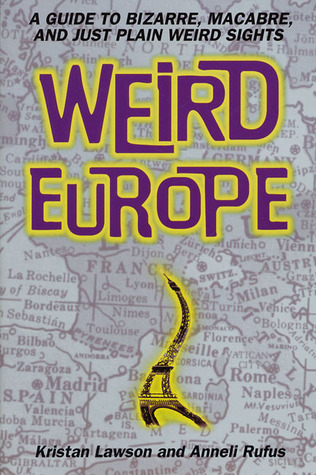
So Google is your friend. But how did travellers find those coolest places before internet? Believe me or not, but there are these things called books! I ran into a wonderfully named guide, Weird Europe (by Kristan Lawson & Anneli Rufus), which is already quite old, my copy being 1999 edition. But it promises bizarre, macabre and just plain weird sights to its reader, including sewer tours, two-headed animals, pictures drawn by dead people and underground cities. It's just a book for me, and despite its age, most of the attractions are still there. Well, the Beatles Museum in Cologne has moved, but the caves, crypts and tombs seldom wander away from their present location. With this book I found about this awesome hedge maze next to a three-country-borderstone, got reminded of certain church chamber that has walls decorated with human bones (video link) and discovered an underground river in Belgium (who would have thought that there are such a many caves in Belgium). Many of the places I have already visited, and I happen to know few attractions that should be mentioned in the book that aren't there, but one thing is sure: I'll never leave for a European country any more without checking Weird Europe contents and index first.

21.7.12

A-maze-ing Borderlands

A boy in Germany, Belgium and The Netherlands
Borders between countries have always interested me. At most places you need to jump through a ton of bureaucratic hoops to cross one. Some places need you to assure with your signature that you are not lunatic, genocidal or a Nazi. The thing I like in the current Europe is that you can cross the borders in most countries by merely stepping over them. No grim faced guards with their guns, no endless car queues, no visa fuzz accomppanied by silly questions. Just go there.

There's also often a change of the language when you go to the other side of a border. However, in border areas the population often mixes with the population on the other side. They share the same culture and often the surrounding languages are spoken fluently in the area. Often also a certain laid-back atmosphere can be detected; people are used to visitors and cultural differences and strangers are not looked upon as weird freaks.

So close, yet so far away.
Those were the lines of our thoughts when we were having breakfast in a local pastry shop in a small Dutch town of Vaals, bordering nearby Belgium and Germany. An elderly couple at the next table were apparently keenly listening to our foreign chatting and when I dug up a map to study, the man saw the opportunity to start a conversation with us asking in very good English if they could help us with the directions. After telling us the way to the nearby three lands point he asked the question that had obviously bugged them since the beginning: What is the language we are speaking? After revealing it's Finnish the woman raised her thumbs up as in a sign of victory. It remained unclear what the man thought our language was. The couple was one of those borderland 'mixed' people, the man being Dutch and and the woman German. They said their common language was mostly German. After the nice chat they left, but soon the man came suddenly back, handing us a little bag of Aachener Printen, local traditional cookie delicacy, as a present and a wish for safe travels. I'd like to think we just encountered some real borderland hospitality!

Wait...                                             ...go!
We went on to see the Drielandenpunt where the Netherlands, Germany and Belgium collide. The place is made into a tourist attraction with sightseeing towers, parking lots, restaurants, gift shops and playgrounds. You can run around the border stone as many times as you want entering from one country to another in seconds, or even be in all the three countries at the same time by sitting on the stone. The highest point of the Netherlands is also here: You can't get higher than 322,5 metres in Holland. 

One way to find a way.
The most fun thing here, however, is The Labyrinth. There is a supercool hedge maze here, where the goal is to reach the platform in the very center of the labyrinth. It's difficult enough as it is already but they have added some 'stone' gates there with built-in water fountains that will wet you badly if you walked through. You have to find a hidden sensor nearby and waving your foot or hand next to it will stop the water for a moment  of unknown length. Better walk through the gate quickly. It gets only more interesting when you spot the sensor on the other side of the gate... There are also three lesser platforms built along the way where you can plan your route towards the center of the maze and watch the other people running into dead ends. On average it takes 30-45 minutes for the visitors to reach the goal and I think that's about what it took us too.