Buy This Book from Book Depository, Free Delivery World Wide
Showing posts with label gear. Show all posts

28.8.13

Weird Europe - How to Find Unusual Attractions

Frightened tourists on an Edinburgh ghost tour.
When I'm traveling, I usually try to find if there's something unusual or exceptional to do or to see in the area. Sometimes even the most common touristy places have totally 'something different' to offer. For example, I never fancied the idea of going to Spanish Costa del sol, which has practically been covered with concrete over the last five decades and which annually sees way more tourists than local people. Of course, there are the wonderful caves of Nerja and the magnificent Alhambra castle in the area, which despite their being perfect school-book examples of tourist traps, are truly mystical and awe-inspiring must-see destinations for anyone. Then again, I dug some more and found out about El camino del rey, the infamous scariest footpath in the world. It's just around the corner in the Sunny Coast, but when I was there the first time I had no idea of the place. The second visit, after some research, resulted to one of the daunting trips I've ever made. Read more about it here.

Lurgrotte Semriach (Austria) gone phallic.
But how to find those different places? How to find the path less travelled? Most tourists don't have the opportunity to spend months and months drifting around, finding the coolest places and the secret beaches that no one has ever heard of. Usually it's the one or two week dash to the destination, some hanging around there, then back home and to the rat race. You can be lucky and find that awesome waterfall or that spectacular food selling street vendor, but it never hurts to do your homework before you even start packing. Usually I start by Googling if there are caves near the destination. Caves are cool (yes, literally too). I mentioned the Nerja caves above, but I've visited also couple of others. Sailed on an underwater river in Belgium. Become awestruck by the Naida caves on an Indian island (video link). Another must-Google for me are ossuaries. I've seen only few of the many European ones and they're fascinating. I'll definitely visit any if there's one nearby my destination.

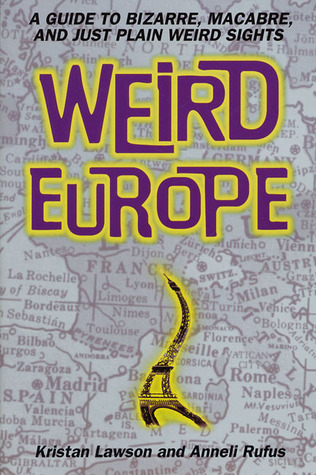
So Google is your friend. But how did travellers find those coolest places before internet? Believe me or not, but there are these things called books! I ran into a wonderfully named guide, Weird Europe (by Kristan Lawson & Anneli Rufus), which is already quite old, my copy being 1999 edition. But it promises bizarre, macabre and just plain weird sights to its reader, including sewer tours, two-headed animals, pictures drawn by dead people and underground cities. It's just a book for me, and despite its age, most of the attractions are still there. Well, the Beatles Museum in Cologne has moved, but the caves, crypts and tombs seldom wander away from their present location. With this book I found about this awesome hedge maze next to a three-country-borderstone, got reminded of certain church chamber that has walls decorated with human bones (video link) and discovered an underground river in Belgium (who would have thought that there are such a many caves in Belgium). Many of the places I have already visited, and I happen to know few attractions that should be mentioned in the book that aren't there, but one thing is sure: I'll never leave for a European country any more without checking Weird Europe contents and index first.

1.6.11

South-East Asia in Yer Face!

More or less the exact spot where I bought the book.
Lying on the beach on the island of Koh Chang in Thailand in the very end of 2004. A man in his fourties walks in on me to sell his book. He briefly tells he's been backpacking in Asia for years, and that he has written down some stories about his travels and offers his book for few US dollars, euros or some Thai bahts. Can't remember the price any more, but it was very reasonable. He hands me a copy and politely retreats few metres away giving me a possibility to browse through the book before I decide if I want to buy it.

The layout and the general appearance of the book is rather shabby. The pages are obviously Xeroxed in some local Asian copying service shop and stapled together with simple plastic binding. The book or, despite its over 120 pages, merely a booklet, has also plastic covers to make it a bit more book-like rather than just a sheaf of notes. On the cover there is the name of the book, South East Asia in Yer Face and the author, Adrian Robson. Illustrations on the cover look like a mixture of cheesy clip-art pictures. The table of contents reveals stories like Bangkok Girls or Komodo or Bust and by riffling through the pages one very soon notices a generous ration of curse words, occasional poor grammar and typos within the text. The man, Adrian himself, points out that the first story, Bukit Lawang,  is about a flash flood occurence in North Sumatra he barely survived and which actually prompted him to write the whole book. That alone is quite intriguing, especially since we're just couple of days away from the Boxing Day tsunami which hit also Thailand heavily. (By that time we didn't yet realise how bad the disaster actually was, and Koh Chang was untouched by the tidal waves.)

- Well, what the hell, I start, intending to buy the book when I notice weird, almost angry expression on Mr. Robson's face.
- What? he asks looking like daggers drawn.
- I said: What the hell, I'll buy this. How much was it again? I reply, and the author markedly calms down and starts smiling again. We close the deal. Small amount of bahts and a book change owners. Mr. Robson thanks, waves goodbye and continues his stroll on the beach to find the next buyer for a copy of his book.

I later realise that I probably had failed using the expression 'what the hell' as in 'sure, why not'. Adrian most likely first thought I meant something like 'what the hell is this crap'. A good example of how easily you can become misinterpreted by speaking a foreign language with only slightly inadequate intonation. And we're not even talking about tonal languages here.

Well, I didn't read the book right away. Instead it travelled with me back to Finland, where it was buried and forgotten in the bookshelf for several years. I recently discovered it again and finally read it. I was first afraid the stories might be mostly about drinking beer and banging prostitutes, but to my delight the stories were more or less pure rock'n'roll - not forgetting the sex and drugs. In the introduction Adrian Robson tells that apart the flash flood, all incidents described are everyday occurrences that can happen to anyone in South-East Asia, the trick being to be in the wrong place at the right time.
 
Somewhere in the book Robson mentions he has no previous experience whatsoever on writing, and to be honest, that becomes quite obvious when reading the book. However, after reading all of the stories, and the separate 'Author's Opinions' section at the end, where Robson compares eight different South-East Asian countries, I must say that I'm very happy to own this quite unique piece of travel literature. Actually, many of the happenings in the book are similar to things I'd like to write in this very blog. Adrian Robson writes in a fun and excited way, and with fucking many swear words. This amateur book manages to do what any professional travel book should: It definitely made me want to go traveling again. To Indonesia!

25.11.10

Vintage Bicycling in England

A tad too big for a 2-year-old.
Couple of summers ago we took our kid to a photographer in Loughborough, England (who also is a friend of ours). During that trip I was introduced to this early version of what we now call a bicycle: the Penny-Farthing. The name is inspired from the size difference between old British penny and quarter penny coin, aka Farthing. The bike owner Mike, who is a relative to the abovementioned photographer, let us sit on the saddle for some high-wheeler tourist poses. He also taught me a bit how to scoot with the velocipede, but the actual mounting  seemed so difficult that we agreed I'd try the actual riding the next time. Mike himself had a sovereign command of Penny-Farthing riding. He made it seem so easy that I became determined to visit him again some day and learn to mount that damned vehicular structure.

Luckily we had an opportunity for another visit in less than a year, and this time I asked if I could try the actual ride on the Penny-Farthing. I have to say I admire the people who in their time used the high wheels for their everyday businesses, commuting etc. Penny-Farthing clearly had a mind of its own, and despite my repeated attempts, I managed to ride only few meters before the bicycle decided I should turn right into a ditch almost falling on Mike.

I made a small silent film pastiche video out of the experience. Yes, Ye Olde English used in the narration frames is very much pseudo old.


27.10.10

Correspondent's Vest

The ultimately best traveller's companion and the thing to bring is a correspondent's vest (aka photographer's vest). You know, that often green or khaki coloured multipocketed piece of garment with lots of zippers and compartments. Sure, depending on the design, it might make you look like you're going to a hunting spree. Or just plain country bumpkin. In the best case scenario, you might resemble a foreign correspondent or a photo journalist. But for a traveller, it's almost as useful as duct tape.

No Sweat!
You can stuff loads of your belongings inside the pockets. It's especially useful in the airports, when you, on your way back home, have filled your luggage with all those souvenirs, awful tasting local liquor bottles and presents, and you're way beyond the airline weight limits. The solution is to wear your correspondent's vest and make use of its pocket space. You can fit several books there as well as some other heavier stuff like electric devices, chargers and so on. It's easy to toss the vest with all its contents in the security check box and have the whole entity X-rayed. You will also look rather silly when wandering about the airport wearing a fully loaded vest.

But it's not only the airport where the correspondent's vest is useful. On the road, it's a practical substitute for handbags and backbags, even without having to stuff it full. You will be able to carry your wallet, passports (if you have to keep them with you), medicine, pocket knife, lighter, notes, maps, pencils, phone, camera, torch etc. very close to your body. The vest naturally doesn't give an absolute protection against pickpockets, but it's harder to steal anything from your breast pocket than from your bag. Plus, you have everything handy should you need it immediately. You can also sew a secret pocket somewhere inside for your emergecy money.

There seems to be a very nice quality version of correspondent's vest on sale. I bought mine, a cheapo version, at Cu Chi tunnels in Vietnam. Its design is quite military-esque, but it has served me well for couple of years. (Well, I recently pulled the slider off of one of the zippers, but what did you expect for a 15 dollar vest.) I learned the awesomeness of this fine piece of clothing from the excellent Travel Channel documentary Madventures by my countrymen Riku & Tunna, where Riku's regular gear is the mighty correspondent's vest.